Free shipping, every order · 90-day guarantee · From Orange, California
The Woodworker's Cup Holder.com ← back to the woodworker's page

The woodworker's guides

A drink on an MFT bench: where it fits, and what a spill does to the hole grid

On a 20 mm dog-hole grid the free zone moves every setup. Where a drink can sit on an MFT bench, and what a spill really does to the holes.

13 min read · 7 sources

A drink on an MFT bench: where it fits, and what a spill does to the hole grid

A dog-hole top isn't furniture. It's a fixture with a coordinate system printed into it, and every hole in it is a place a clamp might have to go. That's the real reason the coffee never has a spot on one: not because the bench is full, but because the part of it that's free keeps moving.

This is about that specific top — a stock MFT, a shop-built 20 mm grid, or a hardwood bench drilled for round dogs and holdfasts. Where a drink can honestly sit on one, what a spill actually does to a perforated top, and what to do in the first minute if you get it wrong.

The grid is not as crowded as it feels

Take the reference case. A stock MFT/3 top is 1102 × 718 mm of MDF, drilled 11 holes by 7 — 77 of them — at 20 mm on 96 mm centers; replacement tops in the same size are sold in 3/4 in MDF, and 3/4 in is also what's recommended for a shop-built one. The table around it measures 1157 × 773 mm, stands 900 mm with the legs unfolded, and is rated to carry 120 kg. Shop-built tops copy the same grid because the accessories are cut to it: Festool's own cam-action clamping elements are made for a "perfect fit" in the 20 mm holes, and replacement-top sellers warn that dogs from different brands run enough under 20 mm to feel loose in the same hole.

Now count what a normal crosscut setup actually consumes. Two dogs on the fence line. A rail bracket at each end. Maybe one clamping element on the offcut side. Call it five or six holes out of seventy-seven. Hole scarcity is not the problem.

The problem is that the free space is not in the same place twice. It's defined by three things that all move:

The rail's arc. The guide rail hinges up and drops across the top on a fixed path. Anything standing in that path gets swept on the way down, and a rail coming down on a tumbler is a rail that also stops registering flat.

The workpiece footprint, one setup from now. An MFT/3 takes a 700 mm workpiece across a top that's 718 mm deep. When the panel goes on, the top is gone — including whatever square foot the mug had claimed twenty minutes ago when the last part was 300 mm long.

What's under the holes. This is the one nobody thinks about until it matters, and it's the one that decides how bad a spill gets. A stock MFT is open frame, so a spill drains to the concrete. A shop-built grid top over a cabinet drains into a drawer of Systainers, sandpaper, and a router. On a perforated bench you don't choose the drink's spot by what's on the top. You choose it by what's underneath.

The edge band is narrower than it looks

The obvious answer — put it on the border, off the holes — dies on the tape measure. On a stock top the distance from the panel edge to the edge of the nearest hole is about 61 mm. Just under two and a half inches, and there's a 15 mm flange running under that edge on the MFT/3. Nothing cup-sized sits wholly on that band, and the band is also the bench's traffic line: the strip your forearm crosses on every pass, and the strip a board overhangs when it's clamped for a cut. Parking a full drink there moves it from "in the way" to "at the edge and in the way."

What a spill actually does to a perforated top

Start with the arithmetic, because it's not intuitive. A 20 mm hole is 314 mm² of opening in a 96 × 96 mm cell of 9216 mm². The top is only about 3.4 percent hole. Ninety-six percent of it is solid.

And it drains anyway. On a 96 mm grid, the farthest any point on the surface can be from the edge of a hole is about 58 mm — half the diagonal between four hole centers, minus the 10 mm radius. Two and a quarter inches. A 12 oz can puts down 355 ml; a 40 oz tumbler puts down nearly 1.2 litres. Neither of those stops inside a 58 mm radius on a flat, waxed-smooth MDF panel. On a grid top, effectively every spill finds holes, and it finds four to eight of them at once.

That's half good news. It doesn't stand in a puddle under your workpiece the way it would on a solid bench. It leaves the surface fast.

The bad news is where it goes. The inside wall of every one of those holes is a raw, unsealed MDF cut edge — the face MDF suppliers tell you to seal first, because that's where the board drinks fastest. Run the numbers on a stock top: 77 holes, 20 mm across, through 19 mm of panel, is roughly 140 square inches of exposed edge grain hiding inside a surface that looks finished.

Then MDF does what MDF does. Standard-thickness commercial MDF tested to EN 317 swells 5.7 to 7.9 percent in thickness after a 24-hour soak, and that swelling is not the reversible kind. Water-induced swelling is largely recoverable in solid wood; in fibreboard it isn't. Drying the panel afterwards does not return it to its old dimensions — the fibres have expanded against the resin bond, and the accuracy goes with them.

Put those two facts side by side and you get the thing that's actually at stake, which is not the mess:

On a dog-hole MDF top, hole diameter is the spec. The grid is a measuring reference — it's what squares your cuts and locates your fence. If the walls of four holes in the middle of your work zone swell by even a fraction of the percentage those tests show, you don't have a stained bench, you have four holes that are no longer the same as the other seventy-three. And you can't sand a hole back to 20.00 mm.

A spill on a perforated MDF top is a local calibration event. Small, survivable, and worth handling like one.

The same spill on a solid-wood dog-hole bench

If your holes are 3/4 in round dogs bored through beech or ash, you get a different and generally better outcome, for a reason worth knowing: solid wood's moisture swelling is largely reversible. A wet bench top mostly comes back.

What doesn't come back for free:

The first 60 seconds

Order matters more than speed here.

  1. Lift the workpiece off the bench before you touch the cup. Water under a panel is the spill that costs you a project. Water on a bench top is a bench top.
  2. Blot; don't wipe. A rag dragged across a hole grid pushes liquid over holes that were dry. Press a towel down, lift, repeat, working inward.
  3. Pull the steel out of the holes — dogs, holdfasts, clamping elements — and dry them somewhere else.
  4. Pull it from underneath. A shop vac held under the affected holes draws the liquid down and out of them instead of chasing it around on top, which is the one job the perforation makes easier. Compressed air blown down the holes does the opposite; it drives it into the edge you're trying to protect.
  5. Air, not heat. A fan across the top overnight. A heat gun on damp MDF closes the surface over a wet core.
  6. Check what's below before you walk away. If it's a cabinet base, open the drawer. That's the thing you'll otherwise find in a month.

The 24-hour check

The EN 317 swelling figures are measured a full day after the panel goes into the water, so the honest test isn't the evening of the spill — it's the next session.

Take the dog you trust most, the one with the fit you know by feel, and run it through the holes that got wet, then through four holes on the far side of the table as a control. If it drops in the same way, you got away with it. If it needs a tap where it used to fall, those holes have moved, and you now know which corner of your grid to stop referencing off.

That's the point where the MFT's one real mercy shows up: the top is a consumable. Replacement tops are sold as reversible — flip it and start again on the other side — precisely because that surface is meant to be cut into, drilled through, and eventually thrown away. It is the cheapest part of the table. Nobody should be nursing a compromised reference surface out of thrift.

Sealing it before, and where sealing backfires

Sealing a shop-built top is worth doing, with two caveats. First, it's insurance, not immunity: sealing slows moisture uptake and doesn't stop it, least of all at cut edges and fixings — which on this top is every hole. Second, and this is the one people learn the expensive way: do not build film finish inside the holes. Your dogs already fit within a fraction of a millimetre — that's why the same dog feels different between brands — and a couple of coats of wipe-on poly around a 20 mm bore is diameter you don't have. Seal the faces and the outside edges. Plug the holes, or drop a dowel in each one, while you do it.

So where does the drink actually go?

There is no correct square on the grid. There's a hierarchy of honest options.

1. Off the grid, at grid height. The best answer to "where on the bench" is usually "not on the bench." A rolling cart, a Systainer stack, or a saw stand set near the working corner puts the drink within a step and out of every geometry that matters — no hole competition, nothing in the rail's arc, no drain path through your reference surface. The reason this fails in practice is that people put the satellite too far away and too low, and a drink you have to walk to is a drink you stop drinking. Set it beside the corner you actually stand at, at roughly bench height, and move it when you move.

2. The dead quadrant, re-chosen each setup. If it's going on the top, it goes diagonally opposite the cut line, on the side the offcut doesn't fall to, over holes with open frame beneath rather than a drawer. This is fine and it is also temporary by definition — the correct habit is that the drink gets relocated when the setup changes, in the same motion as moving the dogs.

3. The edge band. Covered above. It doesn't fit and it's the busiest line on the bench.

4. Fixed holders — cleat, clamp-on, bored block. The instinct to bore a block on the drill press is sound shop reasoning, and it does solve the knock. What it doesn't solve is that it fits the one cup it was sized for and it stays where you put it, which on a grid bench means it's in the wrong place by the third setup. A clamp-on holder has a worse problem specific to this table: it needs the edge profile, and on an MFT that edge is already carrying the fence, the rail brackets, and the T-slot the clamps ride in. You'd be trading workholding real estate for cup real estate, which nobody in this shop is going to do.

And whatever you pick: a lid solves the dust and solves nothing else. A tall insulated bottle with a good lid still goes over when your elbow finds it at the end of a plane stroke; it just goes over quietly.

What keeps one upright on a hole grid

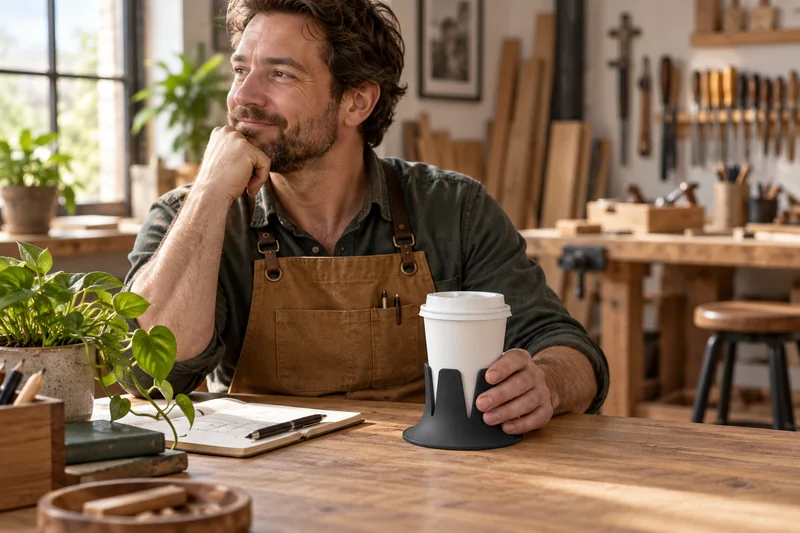
This is where Steadi fits, and it's worth being exact about why, because a grid top is a genuinely different surface from a solid bench.

Steadi is one piece of Shore 85A TPU — not silicone — with a fixed base 5.2 inches across and 2.8 inches tall. The base doesn't expand, contract, or deform; the fins flex to grip the bottom inch of the container. What it does is widen the base of support under the drink. The container's centre of mass has to travel further horizontally before it passes outside that base, so tipping takes a much larger tilt than it does under a bare cup standing on its own footprint. The TPU's tack resists sliding, which is the other half of the problem on a smooth MDF top when a board slides past.

The grid geometry works out in its favour, and the arithmetic is easy to check. The base is 5.2 inches — about 132 mm — sitting on a 96 mm grid of 20 mm holes. Worst case, placed dead centre in a cell, its rim crosses four holes. But the outline of what it's resting on is still the full 5.2 inch circle: most of the rim is on solid MDF between the holes, and the outer boundary — the thing that sets how far the centre of mass has to move — is unchanged. A rigid perforated top behaves like a solid one for this. That is geometry, not a test result, and you can verify it with a ruler on your own bench.

The honest limits, because this crowd checks:

Care is a rinse or the dishwasher. It's molded in Orange, California, patent pending. There's a 90-day guarantee from delivery with free returns, and used is fine — which for a shop object is the only test that means anything: put it on the bench for a season, get it dusty, knock it, and send it back if it didn't earn the spot. Steadi's own store is at steadilabs.com.

The short version

Wondering about your specific cup? The fit database has sourced base measurements for 30+ containers — Stanley, Red Bull, Yeti, and the honest no's.

Sources

  1. Festool Owners Group — A stock MFT top measures 1102 x 718 mm with 11 x 7 holes of 20 mm on 96 mm centres, about 61 mm from the panel edge to the nearest hole edge, and a 15 mm flange under the edge on the MFT/3.
  2. Festool USA — The MFT/3 table measures 1157 x 773 mm, stands 900 mm high with the legs unfolded (180 mm folded), is rated to 120 kg, and takes a workpiece up to 700 mm wide.
  3. Festool USA — Festool's MFT-SP clamping elements are cam-action clamps designed for a perfect fit in the 20 mm holes of the MFT grid.
  4. TSO Products — MFT-style tops are grids of 20 mm holes on 96 mm centres, and 3/4 in MDF is the recommended material for a shop-built top.
  5. TrunkWorks CNC — Replacement MFT/3 tops are 718 x 1102 mm in 3/4 in MDF, are sold as reversible sacrificial surfaces, and hole diameter matters enough that dogs from other brands run smaller and fit looser.
  6. Materials (PMC7795052), National Library of Medicine — Commercial 19 mm MDF tested to EN 317 showed 5.7-7.9% thickness swell after 24-hour water immersion, and water-induced swelling is largely reversible in solid wood but not in fibreboard.
  7. MDF Direct — MDF swelling is irreversible - drying does not restore original size, strength or tolerances - and sealing slows moisture uptake without stopping it, least of all at cut edges and fixing points.
Build the set — free shipping

The buy button goes to steadilabs.com — Steadi Labs makes it.