Free shipping to the shop · 90-day guarantee · Molded in Orange, California
The Woodworker's Cup Holder.com

Finally, somewhere to put your drink in the shop.

122 reviews · 4.9 average · 98 verified purchases
Scott Rodriguez, who makes them.

Steadi Labs LLC — Scott Rodriguez, founder. Veteran founded.

3419 E Chapman Ave #411, Orange, California · hello@steadilabs.com

All 122 reviews, hosted on Judge.me — not on this site →

“First time I have ever ordered from Facebook feed. Very easy. Happy with product.”Steve Butler · 8 August 2026

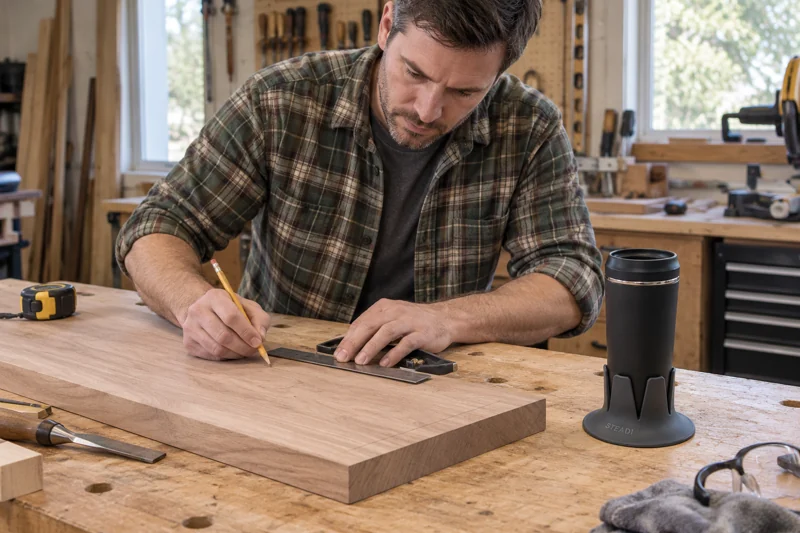
Holds your coffee, water bottle, or end-of-day can steady on the bench, the cast iron, or the outfeed table — no magnet, no clamp, nothing bolted down. It settles back down through a plane stroke's elbow follow-through or a clamp bar swinging past.

Add one to the shop — $14.95

One piece, nothing to snap or unclip — rinse it clean, and 90 days to prove it on your own bench.

Will it fit what you actually bring to the bench? A sticky note answers it ↓

Prefer the maker's own store? steadilabs.com →

Left to right: the wide, low base empty, then holding a cup, a can, and a large tumbler.
One base, bench to cast iron. Empty on the bench, then a cup, a can, and the 40 oz tumbler that makes the walk from the kitchen worth it.

You know the moment

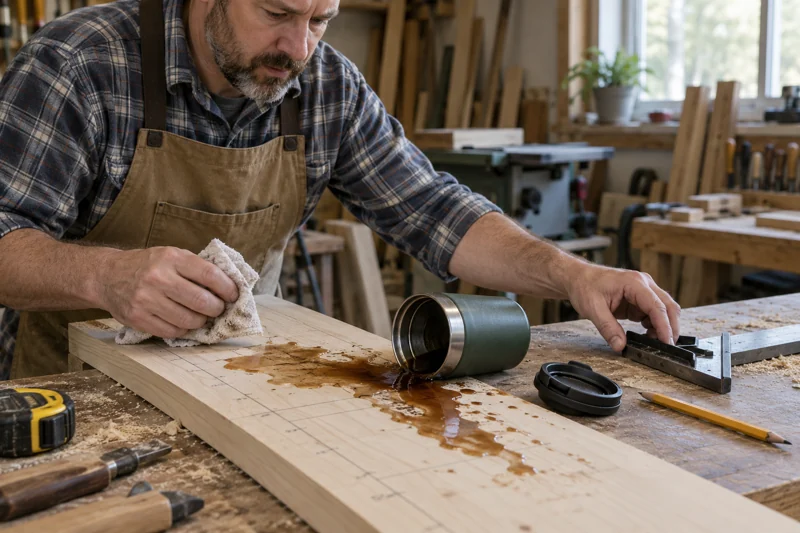
Every project has at least one of these in it.

Minutes into a glue-up

Titebond's open time runs about four to six minutes, squeeze-out is already beading along the joint, both hands are locked on clamp handles — and the coffee sitting in the middle of the assembly table is now exactly where the next caul has to land.

The end of a long sanding session

The ear muffs come off and you reach for the cup that sat open through the last half hour of 220-grit — there's a fine film floating on top, and the shop joke about what's waiting at the bottom writes itself.

Saturday morning, first cut of the day

Coffee walks out from the kitchen and the only flat, empty landing zone in sight is the table saw's freshly waxed cast iron wing — and everyone who's chased a rust bloom off a top knows exactly what a sweating cup does there.

Mid-plane, at the bench

A hand-plane stroke is a full-body follow-through, and the elbow on the back end finds whatever was parked near the edge — the water bottle goes over into the shavings before the stroke even finishes.

The last coat of the evening

The workpiece is wet with poly, the bench is buried in dust, and the assembly table's staging the next coat — so the end-of-day beer ends up on the concrete by a bench leg, waiting for somebody's boot.

Mechanics

Built for the elbow, not the shelf.

The weight rides low and wide.

A shoved clamp or a slid board can tip anything standing on one point of contact. The wide, low base lies flat across the surface instead — bench top, cast iron, or the outfeed table.

The fins grip.

Flexible fins hold the drink by its bottom inch, so the vibration off a planer or a random-orbit sander can't walk it toward the edge.

It settles.

An elbow follows through on a plane stroke, a clamp bar swings past, a board feeds through the planer — the base's low, wide weight rocks with the knock and brings the drink back level.

Nothing anchors to one surface. No magnet tying it to bare steel, no clip sized to one drawer or one machine stand. It sits on top of whatever's flat and closest — the bench this project, the outfeed table the next — and moves the second the job does.

Shop physics

The shop looks flat. It behaves like anything but.

The reason a drink loses ground in a shop isn't clumsiness — it's that everything within reach is either shaking, sweating, draining, or already spoken for by the workpiece.

The workbench top

Standard bench height runs 34 to 36 inches — often chosen so the bench doubles as an outfeed table for the saw — and every hand-tool stroke on it, planing, chopping, chiseling, sends a jolt through the whole surface. Nothing narrow stays put next to that kind of force.

The cast iron table saw top

Machined dead flat and kept waxed against rust — condensation alone is called the leading cause of a rust bloom on cast iron, which is exactly what a sweating can leaves behind. It's also the surface boards slide across mid-cut, so anything parked on it is in the way of the next pass.

The outfeed and assembly table

Doubles as glue-up staging, and a glue-up is a timed event — Titebond's open assembly time runs about 4 to 6 minutes, both hands committed to clamps the whole time. Whatever was sitting in the middle when the clamps came out is now in the work zone.

MFT-style perforated tops

An increasingly common bench style: a grid of 20 mm dog holes on a 96 mm spacing for workholding. A knocked-over drink doesn't pool where you can catch it — it drains straight through onto whatever's stored on the shelf underneath.

Benchtop machine stands

Planers, sanders, and miter stations run on universal motors that vibrate hard enough to be a documented, much-troubleshot nuisance on their own — anything loose on the stand or an attached shelf walks toward the edge the whole time a board is feeding through.

Why drinks go over in a wood shop — and what actually holds one — the full story →

Instant answer

Skip the calipers — the sticky note already has the answer.

your cup's base
lands in here

A square sticky note: 3 inches, exactly — same as the ceiling of what fits, pulled off the same pad you mark cut lines with.

01
Grab a sticky note.

The classic square is exactly 3 inches on a side — a fact about sticky notes, and it happens to land right at the ceiling of what fits.

02
Stand your cup on it before you pick the chisel back up.

Set it on the note, not balanced on the rim. A tapered tumbler or a flared cup lies about its true size — the bottom is the only measurement that counts.

03
Read the note.

Base sits inside the square? It fits. Hangs over the edge? Too wide. A tiny puck lost in the middle — under 2 inches? Too narrow.

No calipers, no spec sheet, no guessing at the store. One sticky note off the pad, one glance, with the cup you actually bring out to the shop.

Fit check

The bottom inch is the only tolerance that matters here.

One rule covers the whole shop: a container base 2 to 3 inches across settles in. Every verdict below follows from it.

  • 40 oz Stanley-style tumbler fits
  • Insulated travel bottle or thermos fits
  • Standard 12 oz can fits
  • 16 oz energy-drink tallboy fits
  • Steel water bottle fits
  • Wide-mouth mason jar fits
  • Disposable 16.9 oz water bottle fits
  • Protein shaker bottle fits
  • Kitchen coffee mug, handled handle in the way
  • Paper espresso cup too narrow
  • Big Gulp-style fountain drink too wide

There's a floor as well as a ceiling — under 2 inches the base sits too loose. The handled coffee mug is the honest exception: the base itself fits, but the handle lands right where a fin needs to grip.

The full fit database — Stanley, Red Bull, Yeti, and 30 more, with sourced base measurements →

The other options

Compared to what's already in the shop.

A magnetic toolbox cup holderThe Woodworker's Cup Holder
Mounting on the wooden benchFerrous steel only — doesn't grip wood at allSits on wood, cast iron, or steel alike
Bench footprintNone — mounted on the toolbox insteadA few inches, but it's actually within reach
Holding the 40 oz tumblerRigid ring sized for a can, not a big tumblerFins flex around the base, tumbler settles in
Holding a can without rattlingSame rigid ring — cans rattle loose in itFins grip the can's base just as snug
Moving to the outfeed tableStuck wherever the steel toolbox sitsThe bench today, the outfeed table tomorrow
SetupNeeds bare ferrous steel within reach firstNo mounting hardware — sits down flat
CostAnother purchase to justifyOne small piece
The magnetic toolbox cup holder

A steel cup on rubber-coated magnets, built for a steel tool chest — and the mount only works on bare ferrous steel, not wood and not aluminum. In a wood shop that puts it on the rolling cabinet, nowhere near the wooden bench where the drink is actually needed, and the rigid ring inside is sized for a can, not the 40 oz tumbler that made the walk from the kitchen.

The clamp-on cup holder

It needs a clean edge of the right thickness to bite — and the edge of a bench is exactly where the vise and the holdfasts already live. A rigid ring fits one cup size or none, and it's competing with actual workholding for the same few inches.

A holder cut from scrap

The native shop instinct: bore a block on the drill press, or hang a French-cleat cup shelf off the same wall everything else lives on. A bored hole only fits the one cup it was sized for, and a cleat-mounted shelf solves the knock-over by putting the drink out of reach again — the walk-across-the-shop problem, just relocated to a different wall.

The lidded travel tumbler, on its own

A lid earns its keep — it's why covered containers are the standing rule in shared shops — but it doesn't solve the knock. A full tumbler still catches a planing elbow or a swung board, and on a cluttered bench it still has nowhere assigned to stand.

From the reviews

What buyers say.

Recent reviews of the Steadi, from every room and rig it lives in.

★★★★★

I have a tendency to spill my drinks and have two cats. This is one of the best things I’ve ever impulse bought. It works. It actually works. It’s a heavy, wide enough base that it is actually stable. My “spot” in the living room is near a somewhat-cushioned fabric ottoman, which is where I usually put my drinks. It’s

Dixie · 2026-08-30
★★★★★

Excellent!

Brian S. · 2026-08-27
★★★★★

It’s great love it

gilbert a. · 2026-08-24
★★★★★

I never knock over my water at night anymore!

Steadi customer · 2026-08-21

Read all 122 reviews →

98 of the 122 published reviews are for the drink base itself. The other 24 are about ordering, shipping and customer service.

Why more than one

Two identical tumblers. One glue-up.

A buddy comes over to help with a glue-up, or a small shop with a crew runs the same big-box tumbler as everybody else. Both cups end up dead center on the outfeed table, and gloved, dusty hands moving fast mid clamp-up don't stop to check whose is whose.

Build your set

Give everyone their own.

Pick a pack, then give each one a color — so nobody has to ask which drink is theirs.

Fair questions

You're probably thinking…

“I could just bore a block on the drill press and have this solved for free in ten minutes.”

Fair, and that instinct isn't wrong — but a bored hole only fits the one cup it was sized for, and it stays wherever it got clamped. This is one piece that fits the mug, the can, and the 40 oz tumbler, and rides the bench today and the outfeed table tomorrow instead of living in one spot.

“Is this the same cheap rubber that cracks or goes stiff in six months like every other garage gadget?”

One piece of flexible material, nothing bonded or bolted to fail. Rinse it, wipe it down, or put it in the dishwasher. If it went stiff or cracked in six months, this wouldn't be a product worth offering 90 days on. The guarantee is the honest test, not a marketing line.

“Is this going to trap moisture against my cast iron and cause the exact rust ring I'm trying to avoid?”

That's not a claim this makes. It's not a sealed cup, so if the paste wax has to stay perfect at the saw, pair it with a lidded bottle there — everywhere else in the shop, an open cup or can is exactly what it's built to hold steady.

“It's one more thing to find a spot for on a bench that's already covered in offcuts and squares.”

It replaces the mug ring, the paper-towel wad, and the search for a clear corner with one object that travels with the project instead of colonizing a permanent spot — net less clutter, not more.

“$15 to $70 for what's basically a rubber puck feels steep for what it does.”

Anchor it against shop math, not a coaster — it's less than a sheet of Baltic birch ply, and cheaper than the magnetic toolbox holder that doesn't even grip a wooden bench. Next to what's already sitting in the shop, this isn't a spend that needs defending.

Before you buy

Asked at the bench, answered here.

Does it actually work on the workbench, or only on something soft?

That's exactly the surface it's built for. Hard, flat ground is where the wide base and the fin grip do their best work — it holds steady on the bench, the outfeed table, or cast iron at least as well as it does anywhere else, no magnet or clamp required. Bump it and it settles back instead of walking toward the edge.

Will it protect my cast iron top from a rust ring?

That's not a claim this makes — it resists tipping and holds the drink steady, which is the part it's built for. It's not a sealed cup, so if the paste wax has to stay perfect, pair it with a lidded bottle on the saw; everywhere else in the shop, an open cup or can is exactly what it holds.

Will my 40 oz tumbler fit?

Measure the bottom, not the rim. A base 2 to 3 inches across settles in — the 40 oz Stanley does. A handled coffee mug doesn't; the handle lands where a fin needs to grip.

Does it clamp or stick to the bench?

No. Nothing clamps, bolts, or sticks to anything. It sits on top of whatever's flat and closest, and it moves with the project — the bench today, the outfeed table tomorrow.

What about vibration from the planer or a benchtop sander?

That's the everyday case it's built around. The base rocks low and wide and resettles the drink when a machine shakes the stand under it — it resists tipping, not a direct hard hit, but the steady vibration of shop machines is exactly what it shrugs off.

Does it keep sawdust out of my coffee?

No — it's not a lid, so the shop's oldest joke still applies: dust that's airborne will still find an open cup over a long sanding session, dust collector running or not. What this stops is the spill, not the dust. If dust in the cup is the real dealbreaker, pair it with an insulated travel bottle.

Can it move from the bench to the assembly table mid-project?

Yes — that's the point. It's one piece with nothing bolted to a single spot, so it rides the bench during the build and the outfeed table during the glue-up, and stows flat on a shelf when the project's done.

How do I clean glue and sawdust off it?

Rinse it, wipe it down, or put it in the dishwasher. It's one piece of flexible material with nothing to trap grit or come apart.

Who makes it, and where do I buy one?

It's called the Steadi, molded in small runs in Orange, California by Steadi Labs — and every order ships free from steadilabs.com, with 90 days to send it back if it doesn't earn a spot in the shop.

All 18 questions, answered →

From

Molded closer than the lumber yard you drive to.

The maker is Steadi Labs, a small veteran-founded company in Orange, California. It's injection molded in small runs, and nothing about it travels far — the mold, the material, and the color runs all sit within about three and a half miles of the shop, closer than most of us drive for lumber. The people who make it read hello@steadilabs.com themselves, usually before the first coffee goes cold on their own bench.

Ninety days at the bench.

Run it through a month of projects. If it doesn't do what this page says — on the bench, at the saw, through the glue-up — email hello@steadilabs.com and it gets made right. No forms, no fight.

Veteran-founded · Patent pending · Made in Orange, California

Keep the coffee off the workpiece.

The coffee stands on the bench, the outfeed table, or the cart — steady through the plane stroke, the clamp reach, and the sander running next door — and the workpiece stays exactly as clean as you left it.

Free up bench space — ships free

Checkout is on steadilabs.com — Steadi Labs is the company that makes it.