The woodworker's file
Every flat surface in a home shop already belongs to something else, which is the real reason a coffee ends up wherever it ends up. Here's the physics of why it tips there, what the usual shop fixes actually solve, and what it takes to keep a drink upright through a glue-up, a sanding pass, or the first cut of the day.
Most rooms have a surface or two built for nothing but idle objects — a side table, a windowsill. A home wood shop mostly doesn't. Bench height across the trade runs 34 to 36 inches, and 34 inches is a common choice specifically because it lets the bench double as an outfeed table for the table saw — so the flattest, most reachable landing spot for a drink is also the surface catching boards mid-cut and absorbing every hand-plane and chisel stroke that lands on it.
The cast iron table saw top looks like the obvious fallback, dead flat and usually clear — but it's kept that way with paste wax, because condensation is the leading cause of a rust bloom on cast iron. A sweating can left there through a coffee break does exactly the damage the wax exists to prevent.
And whatever's left over gets a deadline. Titebond's open assembly time runs about 4 to 6 minutes, and for that whole window both hands are committed to clamps. Whatever was sitting in the middle of the outfeed table when the glue came out is now standing exactly where the next caul has to go.
The two surfaces that look like the answer both fail for reasons that only show up after the fact. An MFT-style bench top, drilled with 20 mm dog holes on a 96 mm grid for workholding, gives a knocked-over drink nowhere to pool — it drains straight through onto whatever's stored on the shelf underneath, which is a worse outcome than a puddle a rag could have caught.
The shelf across the room looks like the safe choice precisely because nothing can knock it over there — and that's the whole problem with it. Fine wood dust stays airborne for hours after a machine shuts off, long enough that wood dust is on California's Prop 65 list, so a cup left open on a distant shelf through a sanding session isn't just going cold, it's collecting a visible film by the time anyone gets back to it.
An object tips when whatever's pushing on it — an elbow, a swinging clamp bar, the vibration off a running machine — shifts its center of gravity past the edge of its own base. The narrower that base is relative to the container's height, the less it takes to cross that line: a squat can with a wide foot has to travel much further off vertical before it goes over than a tall steel bottle or a full mason jar does. That's ordinary physics, not shop physics — it's the same reason a tall glass tips more easily than a mixing bowl — but a shop supplies more of the pushes than most rooms do.
A hand-plane or chisel stroke at bench height is a full-body motion, and the follow-through of that motion is exactly where an elbow lands on whatever was parked near the edge. A benchtop planer or sander runs on a universal motor that vibrates hard enough to be a well-documented, much-troubleshot nuisance on its own, and anything loose on the stand beneath it migrates toward the edge for as long as a board is feeding through. None of that is a single hard knock — it's small, repeated pushes, which is exactly what a narrow-based container has the least margin against.
The instinct to fix this is old enough that a few standard answers already circulate the shop. Magnetic toolbox cup holders — steel cups riding rubber-coated magnets, sold for tool chests — solve the mounting problem for exactly one material: bare ferrous steel. They don't hold to a wooden bench at all, so they end up on the rolling tool cabinet, nowhere near where the drink is needed, and their rigid inner rings, typically about 3.1 to 3.5 inches across, leave a can rattling loose or shut a bigger tumbler out entirely.
Clamp-on holders trade the magnet problem for a real-estate problem: they need a clean edge of the right thickness to grip, and a bench edge is exactly where a vise and holdfasts already live. One widely sold clamp-on holder is rated to hold five pounds — strength was never the weak point, since a rigid ring still only fits the one cup diameter it was bored for.
The shop-built answer — a block bored on the drill press, or a shelf hung off the same French cleat as everything else — solves the sizing problem for one cup and creates a new one: a cleat-mounted shelf puts the drink out of arm's reach again, relocating the walk-across-the-shop problem to a different wall.
A lidded travel tumbler, taken as the whole answer, gets real ground right — covered containers are the standing rule in shared and school shops for this exact reason. But a lid stops what falls into the cup, not what happens to the cup. A full, sealed tumbler still gets caught by a planing elbow or a swung board, with no assigned spot on a cluttered bench.
Fixing this doesn't come down to picking a favorite surface, because the surface itself isn't the constant — the bench today, the outfeed table mid glue-up, the cast iron on a Saturday morning cut are all fair game, and whatever holds the drink has to work on each one without a mount built for only one of them. It can't be sized to a single cup either, because what actually rides out to the shop changes by the hour: the road coffee, a 40 oz tumbler for a long session, a can at the end of the day.
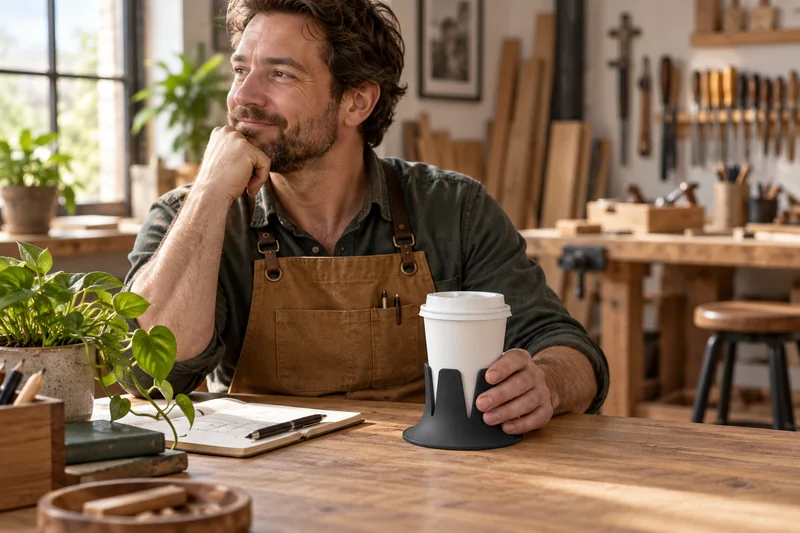
That points to a base that spreads its own footprint wide instead of standing on one point, and to fins that grip a container by its bottom inch rather than locking onto one fixed diameter. A wide, flexible base resists tipping the way a wide-footed can already resists it better than a narrow bottle, no matter what's standing on it. Under the small, repeated pushes a shop produces all day — an elbow's follow-through, a clamp bar swinging past, a board vibrating through a planer — that kind of base settles in and holds steady instead of walking toward the edge, without asking the bench, the cast iron, or the outfeed table for anything a magnet or a clamp would need first.
None of that requires trading the open cup for a lid, or clearing a permanent spot at the bench — it just requires a base built to grip whatever's actually in your hand, on whatever surface happens to be free.
Build the set — free shippingThe buy button goes to steadilabs.com — Steadi Labs makes it.